Money Making Opportunities

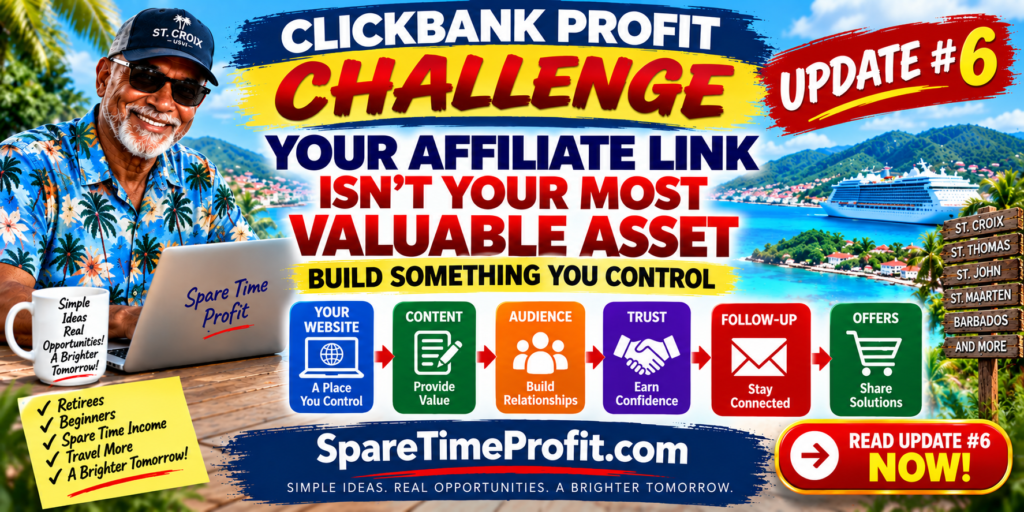
As I continue my ClickBank Profit Challenge journey, I'm starting to look at affiliate marketing differently.
Like many beginners, I once thought the most important thing was finding a good affiliate program, getting my affiliate link and sending as much traffic to that link as possible.
But here's something I'm learning:
Your Affiliate Link Isn't Your Most Valuable Asset
Think about it.
You don't own the affiliate program.
You don't own the product.
You don't control the sales page.
And sometimes you don't even control what happens after someone clicks your affiliate link.
The company can change the offer.
The commission can change.
The sales page can change.
The program itself can change.
That's why I'm beginning to understand the importance of building something around the affiliate link.
What Can You Build That Is Yours?
For me, one answer is the website you're reading right now:
SpareTimeProfit.com
Instead of simply advertising affiliate links, I'm working on building a place where people can:
Read my content.
Follow my ClickBank Profit Challenge journey.
Discover useful resources.
Learn from what I'm learning.
And then decide for themselves whether one of the opportunities I discuss is right for them.
The affiliate offer can change.
But my website can continue.
The Bigger Picture
The last few Challenge updates have helped me see how these pieces connect.
First, we talked about traffic.
Then we looked at what happens after the click.
Next came the importance of opt-ins and follow-up.
Now I'm looking at the asset underneath all of those things.
Your Platform
That could be a blog.
It could eventually include an email list.
It could be useful articles.
It could be videos.
It could be a community.
It could be a combination of several things.
The important point is that you're not relying entirely on someone else's sales page to represent you.
Affiliate Link vs. Affiliate Business
Here's how I'm beginning to see the difference.
Just Promoting a Link
Advertisement → Affiliate Link → Sales Page
If the visitor doesn't buy, that may be the end of the relationship.
Building Something Around the Link
Traffic → Your Content → Trust → Opt-In → Follow-Up → Relevant Offers
Now the affiliate link is part of a larger system.
That's a very different way of thinking.
My Own Spare Time Profit Example
This Challenge has already caused me to make changes to this blog.
I'm publishing regular Challenge updates.
I'm organizing my content around subjects that can help beginners.
I've created clearer paths for visitors who want to learn more about ClickBank Profit Club.
And I'm beginning to think beyond one promotion.
That's important because Spare Time Profit isn't supposed to exist for one affiliate offer.
My goal is to build a useful resource around topics that interest me and may also interest other retirees and beginners—including online income ideas, travel, Caribbean living and practical resources for everyday life.
The individual offers may change over time.
The platform remains.
Why This Matters to Me as a Retiree
I've already retired twice—from the military and from the Department of Defense.
I'm not looking to replace retirement with another full-time job.
What interests me is building something useful during my spare time that can continue working after I close the laptop.
An article I publish today can still be available tomorrow.
My blog can continue receiving visitors.
Older Challenge posts can continue introducing people to newer posts.
And when I discover something worthwhile, I have my own place to talk about it.
That feels much more like building an asset than simply collecting affiliate links.
Build the Asset First
This may be one of my biggest lessons so far:
Don't make the affiliate link the center of your business.
Build useful content around the interests and problems of the people you want to reach.
Then affiliate products can become possible solutions within that content.
For me, that means continuing to improve SpareTimeProfit.com one step at a time.
I'm certainly still learning.
That's exactly why I'm documenting the journey.
We're Getting Closer to the Live Challenge
The 3-Day Live ClickBank Profit Challenge is scheduled for October 6–8.
As we get closer, I'll continue sharing what I'm learning, what I'm changing and what I think beginners should pay attention to.
If you're following along, we're building this picture piece by piece:
Traffic → Click → Content → Trust → Opt-In → Follow-Up → Offers
But underneath all of it:
BUILD SOMETHING YOU CONTROL.
Want to See the Challenge I'm Following?
If you'd like to investigate the ClickBank Profit Challenge for yourself:
? CLICK HERE TO CHECK OUT THE CLICKBANK PROFIT CHALLENGE
Read the information and decide whether it fits what you're trying to build.
Coming Next — Update #7
Stop Trying to Sell Everybody
One of the next lessons I'm working on is understanding who I'm actually trying to reach.
More visitors aren't necessarily better visitors.
And an offer that's right for one person may be completely wrong for another.
In Update #7, we'll look at why finding the right audience may be more valuable than trying to sell to everyone.
Stay tuned.
Gregory
Spare Time Profit
Simple Ideas. Real Opportunities. A Brighter Tomorrow.
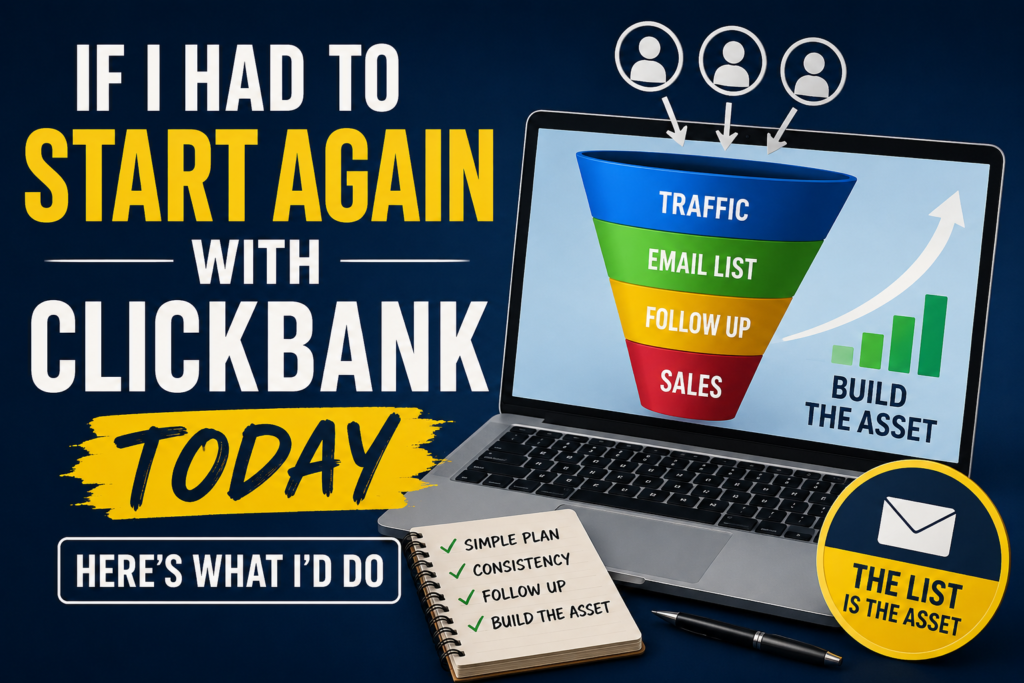
If I had to start again with ClickBank today, I would do far less.
That might sound strange.
Surely the answer is to find more offers, use more traffic methods, build more funnels and learn more strategies?
I used to think that way too.
But there is a problem with trying to do everything at once.
You can become incredibly busy without actually building anything that belongs to you.
You jump from offer to offer.
You try another traffic method.
You change your pages.
You watch another training video.
And before long, you have plenty of activity but very little to show for it.
If I could start again, I would take a much simpler approach.
1. I Would Choose One Clear Outcome
Not ten goals.
One.
And it would not simply be "make money online."
I would focus on building a simple affiliate system that helps me grow an email list while promoting offers.
That distinction matters.
Because once the goal becomes building an asset rather than chasing the next commission, you start making very different decisions.
You stop asking:
"What should I promote next?"
And start asking:
"What am I actually building?"
That is a much better question.
2. I Would Stop Treating the Offer Like the Business
This is one of the biggest lessons I would take back with me.
The offer is not the business.
An offer can change.
A product can stop converting.
A promotion can come and go.
But if you are building your own list and have a way to follow up with the people who showed an interest, you are building something you can continue to develop.
Instead of sending someone straight to an affiliate offer and potentially losing that person forever, I would focus on keeping the lead.
That means thinking about the whole system:
Traffic.
Lead capture.
The email list.
Follow-up.
Offers.
Consistency.
Suddenly affiliate marketing starts looking less like constantly hunting for the next commission and more like building a real business asset.
3. I Would Follow a Simple Build Order
One of the easiest ways to stay stuck is to keep working on everything at the same time.
You create a page, then decide it needs changing.
You write an email, then rewrite it twenty times.
You start thinking about traffic, then discover another tool.
Before long, you are back watching videos instead of finishing the basics.
I would do things differently.
I would follow one clear build order and concentrate only on the next important step.
Finish it.
Then move on.
This is one of the reasons I like the approach behind John Thornhill's ClickBank Profit Club.
It is built around a simpler model of affiliate marketing, list building and follow-up, rather than expecting beginners to piece everything together from scratch.
There is also a free membership, so you can look at the approach before deciding how far you want to take it.
4. I Would Build Consistency Before Chasing More Traffic
It is tempting to think more traffic will fix everything.
But sending more people into a system that is not ready does not solve the underlying problem.
If I were starting again, I would first build a routine I could realistically maintain.
Even during busy weeks.
That might mean creating content consistently, sending traffic regularly and continuing to improve my follow-up.
Nothing complicated.
Just repeatable actions.
Because a simple routine you actually follow is more useful than an ambitious plan you abandon after a week.
5. I Would Build the Asset First
This would probably be the biggest change of all.
I would build my email list from day one.
Think about what happens when you send someone directly to an affiliate link.
They click.
They look at the offer.
Maybe they buy. Maybe they don't.
If they leave, you may never have another opportunity to speak to them.
Building a list changes the relationship.
Now you have an opportunity to follow up, provide useful information, build trust and introduce relevant offers over time.
That is why the list matters so much.
Keep the lead, not just the click.
That is the shift I wish more beginners understood.
The ClickBank Restart Plan I Would Follow
If I had to reduce everything above to a simple plan, it would look like this:
Pick one clear outcome.
Build the system, not just the promotion.
Build your list from the beginning.
Follow up with your leads.
Keep the process simple enough to follow consistently.
Then give it enough time to learn what is actually working before jumping to something else.
You do not need ten strategies competing for your attention.
You need a clear starting point and a model you understand.
Want to See the Free ClickBank Profit Club Membership?
If you are a beginner, or you have tried affiliate marketing before and found yourself overwhelmed by all the moving parts, this is worth taking a closer look at.
The ClickBank Profit Club is built around the same principles I have covered here, including list building, follow-up and a simpler approach to affiliate marketing.
You can take a look at the free membership here:
Start by understanding the model.
Then decide whether it makes sense for you.
If I had to start again with ClickBank today, I would do far less.
That might sound strange.
Surely the answer is to find more offers, use more traffic methods, build more funnels and learn more strategies?
I used to think that way too.
But there is a problem with trying to do everything at once.
You can become incredibly busy without actually building anything that belongs to you.
You jump from offer to offer.
You try another traffic method.
You change your pages.
You watch another training video.
And before long, you have plenty of activity but very little to show for it.
If I could start again, I would take a much simpler approach.
1. I Would Choose One Clear Outcome
Not ten goals.
One.
And it would not simply be "make money online."
I would focus on building a simple affiliate system that helps me grow an email list while promoting offers.
That distinction matters.
Because once the goal becomes building an asset rather than chasing the next commission, you start making very different decisions.
You stop asking:
"What should I promote next?"
And start asking:
"What am I actually building?"
That is a much better question.
2. I Would Stop Treating the Offer Like the Business
This is one of the biggest lessons I would take back with me.
The offer is not the business.
An offer can change.
A product can stop converting.
A promotion can come and go.
But if you are building your own list and have a way to follow up with the people who showed an interest, you are building something you can continue to develop.
Instead of sending someone straight to an affiliate offer and potentially losing that person forever, I would focus on keeping the lead.
That means thinking about the whole system:
Traffic.
Lead capture.
The email list.
Follow-up.
Offers.
Consistency.
Suddenly affiliate marketing starts looking less like constantly hunting for the next commission and more like building a real business asset.
3. I Would Follow a Simple Build Order
One of the easiest ways to stay stuck is to keep working on everything at the same time.
You create a page, then decide it needs changing.
You write an email, then rewrite it twenty times.
You start thinking about traffic, then discover another tool.
Before long, you are back watching videos instead of finishing the basics.
I would do things differently.
I would follow one clear build order and concentrate only on the next important step.
Finish it.
Then move on.
This is one of the reasons I like the approach behind John Thornhill's ClickBank Profit Club.
It is built around a simpler model of affiliate marketing, list building and follow-up, rather than expecting beginners to piece everything together from scratch.
There is also a free membership, so you can look at the approach before deciding how far you want to take it.
4. I Would Build Consistency Before Chasing More Traffic
It is tempting to think more traffic will fix everything.
But sending more people into a system that is not ready does not solve the underlying problem.
If I were starting again, I would first build a routine I could realistically maintain.
Even during busy weeks.
That might mean creating content consistently, sending traffic regularly and continuing to improve my follow-up.
Nothing complicated.
Just repeatable actions.
Because a simple routine you actually follow is more useful than an ambitious plan you abandon after a week.
5. I Would Build the Asset First
This would probably be the biggest change of all.
I would build my email list from day one.
Think about what happens when you send someone directly to an affiliate link.
They click.
They look at the offer.
Maybe they buy. Maybe they don't.
If they leave, you may never have another opportunity to speak to them.
Building a list changes the relationship.
Now you have an opportunity to follow up, provide useful information, build trust and introduce relevant offers over time.
That is why the list matters so much.
Keep the lead, not just the click.
That is the shift I wish more beginners understood.
The ClickBank Restart Plan I Would Follow
If I had to reduce everything above to a simple plan, it would look like this:
Pick one clear outcome.
Build the system, not just the promotion.
Build your list from the beginning.
Follow up with your leads.
Keep the process simple enough to follow consistently.
Then give it enough time to learn what is actually working before jumping to something else.
You do not need ten strategies competing for your attention.
You need a clear starting point and a model you understand.
Want to See the Free ClickBank Profit Club Membership?
If you are a beginner, or you have tried affiliate marketing before and found yourself overwhelmed by all the moving parts, this is worth taking a closer look at.
The ClickBank Profit Club is built around the same principles I have covered here, including list building, follow-up and a simpler approach to affiliate marketing.
You can take a look at the free membership here:
Start by understanding the model.
Then decide whether it makes sense for you.
Warning! 70% off sale ending The huge 70% off everything sale is closing at midnight!
Use code SPRING70 to get 70% off anything in the system!
Hi ##FIRSTNAME##,
I want to tell you about something that happened this week because it perfectly
shows how this whole system works when you put the pieces together.
A brand new member joined on Wednesday. They paid 17 to upgrade their account
and 29 for a single share of the Advertising Co-Op. That is 46 total out of pocket.
By Friday morning, they had $370 in commissions.
Let me say that again. 46 in. 370 out. In less than 48 hours.
How? Because the Co-Op placed 10 real members on their team. Those members
started sending emails. Some of them upgraded. Each upgrade paid a 50 commission.
And on top of that, every click those team members generated paid them 10 cents.
This is not a theory. This is what happened this week. To a person who just got started.
And they are not the only one. Another member who joined last Sunday pulled in $950
in their first week. Look if You are Not a Member, Please Click Here To Signup Now!
https://clickerrtrial.com/clickerrtrialv1?sid=10056
Here is what you need to understand. The Co-Op upgrade commitment is closing. That
means after it is gone, we are no longer committing to a specific number of upgraded
members on each package. Right now, if you buy the 29 share, we commit to at least 1
upgraded member. That is at least 50 back on a 29 investment on day one.
That commitment goes away soon. Once it does, it is not coming back.
The Co-Op starts at just 29 with code SPRING70. That is 70 percent off.
Click here to see the Co-Op now
NOTE: If Not A Member Click Here To Join Now!
Gregory
“Why More Retirees Are Looking for Spare-Time Income Online”
Retirement should feel relaxing…But for many people today, retirement income simply doesn’t stretch as far as it used to.

Prices continue to rise.
Bills never stop.
And many retirees are quietly searching for ways to bring in extra income without returning to a stressful full-time job.
That’s one reason more people are exploring simple online income opportunities they can work on in their spare time.
The good news?
You no longer need:
-
a huge office
-
complicated tech skills
-
or years of experience